Writing
Turn notes into useful posts: the Life = Content loop
updated 2026-09-17
To turn notes into useful content, capture what happened, distill the lesson, and choose where it belongs. A note can become a post, a checklist, an agent skill, or a small build. It can also stay private.
I call this loop Life = Content. The goal is to reuse what I learn without turning note-taking into another job.
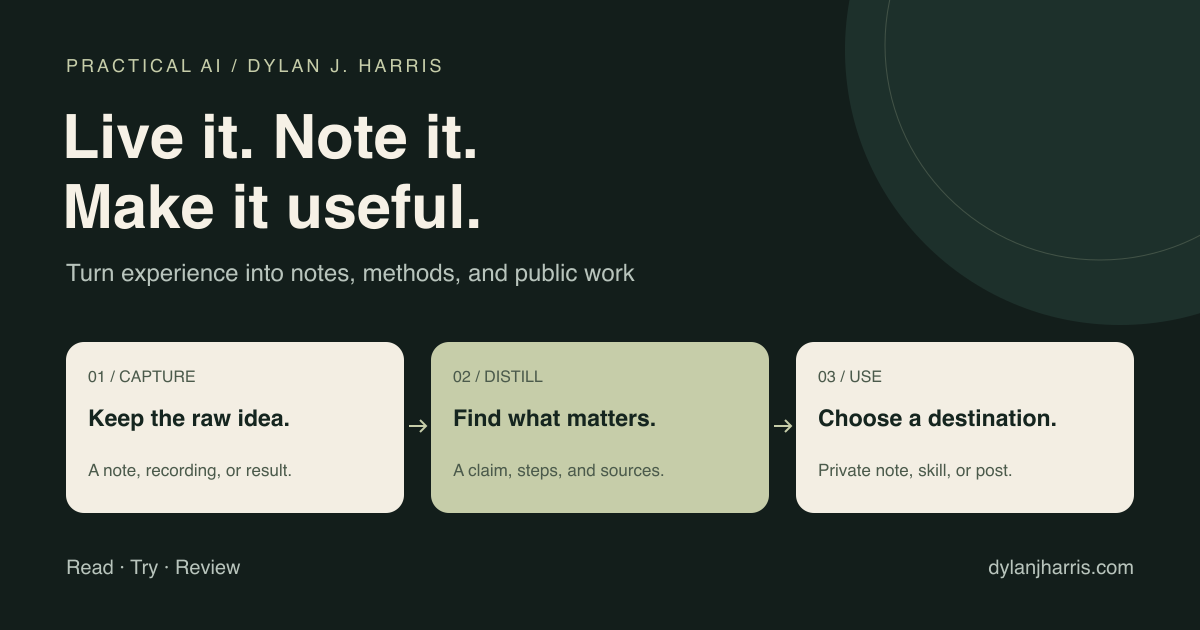
What is the loop?
| Step | What you do | What you keep |
|---|---|---|
| Capture | Save the observation while it is fresh | Raw note, date, and source |
| Distill | Explain the useful part to a friend | One claim, one example, one next action |
| Publish | Choose a form someone can use | A post, skill, checklist, or build |
This sits close to Tiago Forte's CODE method: Capture, Organize, Distill, and Express. Forte already treats creating and sharing useful work as a purpose of the system. My version is a smaller routine, not an invention of the publishing step. Forte's introduction to Building a Second Brain
How do you keep a second brain useful?
For me, the test is upkeep. If the system needs perfect tags before I can save a thought, I will eventually stop using it.
Capture the thought, then organize it enough to find it again. Spend extra effort on notes that serve a real project.
An archive is allowed to be incomplete. Its job is to help with the next piece of work.
Try a 20-minute weekly pass
Set a timer. This is a starting limit, not a rule for every person or project.
- Open the week's captures.
- Pick up to three notes that still matter.
- Distill each into a claim, an example, and a next action.
- Check sources and remove private details.
- Choose a destination. Aim to finish one small useful artifact.
If nothing is ready, do not force a post. A clear private procedure is still progress.
What does a raw note become?
One example from my workflow:
Agent skipped the footer four times. Memory did not help. A pre-call reminder did not help. A post-response hook did.
That note contains a reusable distinction:
- Claim: An instruction asks for a format. A code step can apply the format after generation.
- Example: A required footer can be appended by the output pipeline.
- Check: Confirm that every output path uses that step, including errors and retries.
- Destination: A short how-to or a reusable agent procedure.
Keep the claim within the evidence. One successful fix does not prove that all hooks enforce all rules. The useful article explains the conditions that made this fix work.
A template you can reuse
Working title:
What happened:
The reusable lesson:
One concrete example:
Steps someone else can follow:
Source or evidence:
Limits and exceptions:
Private details to remove:
Destination: private note / skill / post / build
AI can help turn the note into a draft. Ask it to preserve the evidence and mark missing facts. Do not let a tidy paragraph invent an experience you did not have.
What should stay private?
Publish the method, the checklist, and the example you have permission to share.
Keep credentials, client records, private messages, and identifying details out of the public version. Anonymize carefully: removing a name may not be enough if the remaining facts identify the person.
If the lesson needs private evidence, explain the limit or keep the piece private. A useful note does not owe the internet a public version.
When should a note become an agent skill?
Use a skill when you want an agent to repeat a procedure. Give it a clear trigger, required inputs, steps, checks, and an expected result.
A post explains the method to a reader. A skill tells an agent when and how to use it. They can come from the same note, but they need different editing.
See the guide to managing agent skills to make the procedure available in your next session.
Frequently asked questions
Do I need a specific notes app?
No. Use a tool you will open and can search. I use a private vault for capture and Markdown for public posts. The routine matters more than the app.
Should I publish every note?
No. Most notes are context, reminders, or unfinished thoughts. Publish the few that offer a useful method or example and are safe to share.
How is this different from a journal?
A journal can record the day. This routine adds a review step that finds reusable lessons. The same note can serve both purposes.
How long should the finished post be?
Long enough to explain the claim, show an example, and state the limits. A small lesson can stay small. Do not turn a checklist into a book to make it look important.